
When sourcing hot & cold packs for the European market, one important question is often overlooked:
Does this product need to comply with the EU Medical Device Regulation (MDR)?
The answer depends largely on how the product is intended to be used and how it is marketed.
A hot & cold pack is not automatically a medical device simply because it is applied to the body. Under Regulation (EU) 2017/745, the manufacturer’s intended purpose is a key factor. This intended purpose is determined from information supplied by the manufacturer, including the label, instructions for use, and promotional or sales materials.
For importers, distributors and private-label brands, understanding this distinction is important before choosing a supplier.
What Is MDR?
MDR stands for the Medical Device Regulation (EU) 2017/745.
It is the European Union regulation governing medical devices placed on the EU market.
The regulation establishes requirements covering areas such as:
- Safety and performance
- Risk management
- Technical documentation
- Clinical evaluation
- Post-market surveillance
- Manufacturer responsibilities
- Conformity assessment
- CE marking
MDR has applied to medical devices since May 26, 2021.
But there is an important point buyers should understand:
MDR is the regulation. It is not simply a “certificate” that every hot & cold pack must have.
For a product that is a medical device, the manufacturer must follow the applicable conformity assessment procedure. Once conformity has been demonstrated, the manufacturer prepares the EU Declaration of Conformity and, where applicable, affixes the CE marking.
When Does a Hot & Cold Pack Need MDR?
The first question to ask is:
What is the intended purpose of the product?
Under MDR, a medical device includes products intended for specific medical purposes, including the treatment or alleviation of disease, or the treatment or alleviation of an injury or disability.
This means that two products with very similar physical designs can potentially have different regulatory status depending on their intended purpose and claims.
Example 1 — Non-medical cooling product
“Reusable gel ice pack for lunch boxes, cooler bags and picnic bags.”
The product is positioned for food and beverage cooling rather than a medical purpose.
It would generally not fall under MDR on that basis.
Example 2 — Medical hot & cold pack
“Reusable hot & cold pack intended for the temporary relief of pain associated with minor injuries.”
The product is now presented with a medical intended purpose.
The applicable MDR requirements may therefore become relevant.
Why Do Product Claims Matter?
This is one of the most important points for buyers.
The intended purpose under MDR is not determined only by what the product looks like.
It is also linked to what the manufacturer says the product is intended to do.
That information can appear on:
- Product labels
- Packaging
- Instructions for use
- Product descriptions
- Promotional materials
- Sales materials
The European Commission’s MDR framework defines intended purpose using these types of manufacturer-supplied information.
So, for a B2B project, the following should be considered together:
Product design + intended purpose + claims + classification + conformity assessment
When Might MDR Not Be Required?
Not every cold pack or gel pack is a medical device.
For example, products designed and marketed exclusively for:
Food & Beverage Cooling
- Lunch boxes
- Picnic bags
- Cooler bags
- Beverage cooling
- General-purpose cooling
may generally fall outside the MDR when they have no medical intended purpose.
However, a final regulatory assessment depends on the specific product, its intended purpose and applicable EU rules.
For this reason, buyers should avoid making the decision based only on the product name.
What Is the Benefit of Working With an MDR-Capable Manufacturer?
For B2B buyers, having an experienced medical-device manufacturing partner can be valuable when developing products intended for regulated healthcare markets.
1. A stronger compliance foundation
Medical-device projects require more than simply producing a physical product.
The MDR framework includes requirements around quality management, technical documentation, risk management, clinical evaluation, post-market surveillance and other manufacturer responsibilities.
Working with a manufacturer already operating within an MDR conformity-assessment framework can provide a stronger starting point for regulated product development.
2. Better support for private-label projects
For brands developing their own hot & cold therapy products, choosing the right manufacturer early can make regulatory coordination easier.
Before production begins, buyers may need to discuss:
- Intended purpose
- Product claims
- Materials
- Packaging
- Labeling
- Technical documentation
- Applicable testing
- Regulatory responsibilities
This is particularly relevant to private-label, OEM and ODM projects.
3. More confidence when evaluating suppliers
Instead of asking a supplier:
“Do you have MDR?”
A more useful question is:
“Can you provide the MDR documentation applicable to this product and explain its intended purpose, classification and conformity assessment route?”
This allows buyers to verify whether the supplier’s documentation actually relates to the product they plan to purchase.
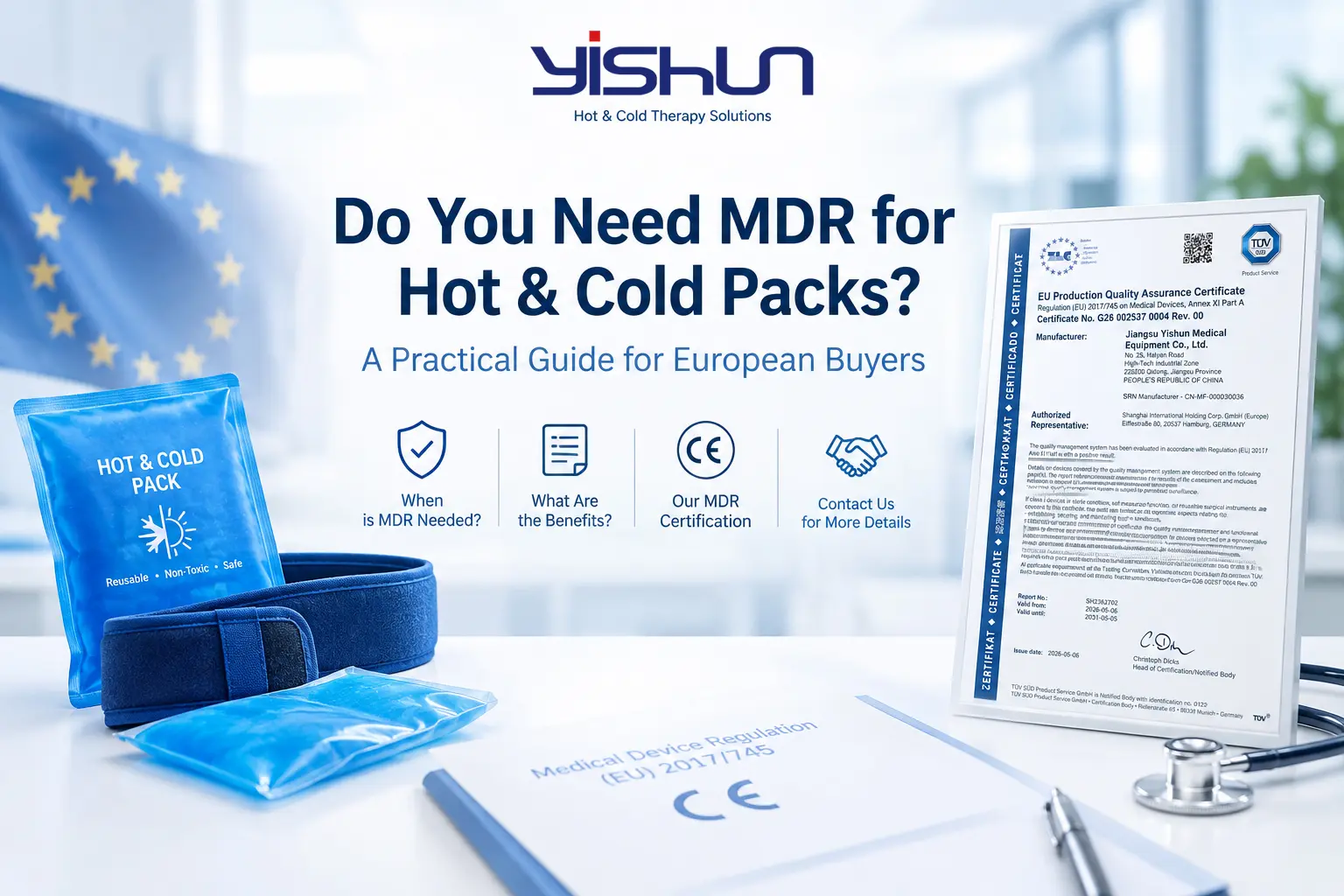
Yishun's MDR Certification
Supporting Medical-Device Projects With a TÜV SÜD-Assessed Quality System
Jiangsu Yishun Medical Equipment Co., Ltd. is a manufacturer specializing in hot & cold therapy products and reusable gel ice packs.
Our company holds an:
EU Production Quality Assurance Certificate
under:
Regulation (EU) 2017/745 on Medical Devices (MDR), Annex XI Part A
The certificate was issued by:
TÜV SÜD Product Service GmbH
EU Notified Body No. 0123
Certificate No.:
G26 002537 0004 Rev. 00
The certificate shown on this page is valid from:
May 6, 2026 to May 5, 2031.
Under MDR Annex XI Part A, the production quality assurance route requires the manufacturer to implement the approved quality management system for the devices concerned, perform final verification and remain subject to notified-body surveillance.
This provides an important quality and regulatory foundation for our medical-device manufacturing activities.
Need to verify our MDR documentation? Contact Yishun and we can provide the relevant certificate and supporting documentation for review.
MDR Does Not Mean Every Product Is Automatically Covered
This is something we believe every buyer should understand.
A supplier having an MDR-related certificate does not automatically mean that every product it manufactures is covered by that certificate.
The relevant scope, intended purpose, product classification and conformity assessment documentation should be checked for the specific device.
This is particularly important for OEM projects.
For example, if you are developing a new:
- Hot & cold pack
- Reusable gel ice pack
- Instant cold pack
- Ice pack wrap
- Migraine relief product
the regulatory status should be evaluated based on the specific product and intended purpose.
What Should You Ask Your Hot & Cold Pack Supplier?
Before starting an OEM or private-label project, ask your supplier:
1. Is the product intended for medical use?
Ask for the exact intended purpose.
2. What is the product classification?
Classification is determined using the MDR classification rules and the device’s intended purpose.
3. What conformity assessment procedure applies?
This tells you how conformity with MDR is being demonstrated.
4. Can you provide the applicable certificate?
Ask to review the relevant certificate rather than relying on a general statement such as “MDR certified.”
5. Does the documentation cover the exact product?
This is especially important for private-label projects.
MDR or Non-MDR: Which Route Is Right for Your Product?
There is no universal answer.
It depends on your:
Product → Intended Purpose → Claims → Classification → Market
For a consumer cooling product, MDR may not be applicable.
For a hot & cold pack with a defined medical intended purpose, MDR requirements may apply.
The important thing is to determine the regulatory pathway before you finalize your product positioning, packaging and marketing claims.
Looking for a Hot & Cold Pack Manufacturer With MDR Experience?
At Jiangsu Yishun Medical Equipment Co., Ltd., we provide hot & cold therapy products for international B2B customers and support OEM, ODM and private-label projects.
With our experience in hot & cold pack manufacturing and our MDR-related quality and conformity-assessment framework, we can support customers who need a manufacturing partner for regulated medical-device projects.
Want to verify our MDR documentation?
Contact our team to discuss your product, intended purpose, target market and certification requirements.
Request MDR Documentation →
Regulatory Disclaimer
This article provides general information about EU MDR requirements and is not legal or regulatory advice.
The regulatory status and classification of a specific product depend on its intended purpose, claims, design, characteristics and the applicable MDR rules. Buyers should obtain product-specific regulatory advice where necessary.
Official References
Regulation (EU) 2017/745 on Medical Devices — EUR-Lex
European Commission — Medical Devices